

Sequestering CO2 may disrupt nearby salt caverns?
Prompts conflict between operators
 If you knew that a carbon storage project
would attract several industry objectors taking many months for approval and
perhaps sparking a hearing, would you start on such a project?
If you knew that a carbon storage project
would attract several industry objectors taking many months for approval and
perhaps sparking a hearing, would you start on such a project?
One operator claims that a neighbor’s CO2 disposal scheme could cause induced seismicity disrupting their salt cavern storage. Will it cause the cavern to leak?
Get all their plans, their geological isopach mapping, pressure distribution maps, and dense phase PVT from the AppIntel AI self-serve portal.
Get details of this cool tech Subscribers get them for freeTo date four major energy companies have raised objections that induced seismicity from the carbon storage project may damage salt caverns in the deep strata. A leak in these underground storage facilities could potentially cost billions of dollars in lost propane and butane.
For more information on this dispute, on the risk of induced seismicity, and background on deep well salt cavern storage, ask AppIntel AI. AppIntel is the best source of oil and gas information more trustworthy than other LLMs because it is based on the best information submitted by oil and companies and vetted by the picky regulator.
Sequestration wars: AppIntel AI shows you how to skirt objections
 Need to make friends with objectors
as fierce as lions? AppIntel AI can help you decide how to avoid some
objections in the first place.
Need to make friends with objectors
as fierce as lions? AppIntel AI can help you decide how to avoid some
objections in the first place.
When development planning, you never expect government approval to be the long delivery item on your project plan. Unfortunately, approval can hold you up longer than pipe delivery or drilling rig access. Dealing with local and global objectors are some of the six ways that AppIntel AI helps speed up regulatory approvals.
See all the CO2 disposal projects in AppIntel AI
AppIntel AI contains all the details on all the CO2 injection/disposal projects. Where else would you find this information: PVT to industry objections?
 One operator is planning a CO2
Sequestration scheme in a very deep zone to store almost a hundred million
tonnes of carbon. Their hazard assessment includes induced seismicity.
The regulator took six months to approve with several rounds of supplemental
information requests.
One operator is planning a CO2
Sequestration scheme in a very deep zone to store almost a hundred million
tonnes of carbon. Their hazard assessment includes induced seismicity.
The regulator took six months to approve with several rounds of supplemental
information requests.
Without AppIntel AI, how would you see how other operators are taking advantage of the current tax and royalty breaks?
 In an advanced new technology disagreement,
two operators are tussling before the regulator. One wants to sequester
CO2 into a formation. The other claims that CO2 sequestration poisons
their brine lithium rights. This dispute has been escalated. Where
will it resolve?
In an advanced new technology disagreement,
two operators are tussling before the regulator. One wants to sequester
CO2 into a formation. The other claims that CO2 sequestration poisons
their brine lithium rights. This dispute has been escalated. Where
will it resolve?
When trying to resolve disputes, you need
to know the regulator’s precedents. What do they consider? Which elements
bring the most weight to the decision? AppIntel AI finds dispute
precedents quickly.
 One operator started a CO2 miscible flood. I met their sole
young flood engineer. She had completedauniversity
project on miscible flooding which included a simulation. It was very
inexpensive to hire her.
One operator started a CO2 miscible flood. I met their sole
young flood engineer. She had completedauniversity
project on miscible flooding which included a simulation. It was very
inexpensive to hire her.
However, there's much more to miscible flood engineering than a school term project. Even though the EIT played with a simulation, she didn't know how to get the CO2 flood to make money.
 Some
operators are sequestering CO2 in deep well disposal. If that is your strategy,
you may need a Measurement, Monitoring and Verification plan.
Some
operators are sequestering CO2 in deep well disposal. If that is your strategy,
you may need a Measurement, Monitoring and Verification plan.
One operator must amend his MMV plan with the Department of Energy before he amends his miscible flood. The AER refused to amend his flood without amendment of the DOE MMV approval.
Without AppIntel, how can your find other operators that submitted such a plan for injection projects? Inside AppIntel you can search in the KiP box for the wordsmeasurement plan. You will find all the documents where it is mentioned.
 One operator proposed modifications to an immiscible
CO2 flood. In his application, he reported on the progress of the flood and
claimed additional recovery by several means even without miscibility.
One operator proposed modifications to an immiscible
CO2 flood. In his application, he reported on the progress of the flood and
claimed additional recovery by several means even without miscibility.
Can a CO2 flood be run at low pressure? If so, how will successful will it be? What other operational concerns does this add?
Understanding the intelligence contained in this application is important to anyone wanting to try a CO2 flood.
 You've
heard of hydrocarbon miscible flood as a tertiary recovery method. But what
comes after that?
You've
heard of hydrocarbon miscible flood as a tertiary recovery method. But what
comes after that?
One operator is going to sweep a miscible flood with CO2. He claims extra recovery, better areal and vertical conformance and better sweep.
And you'll never guess where he's going to get his CO2. Most CO2 miscible floods get their injectant from chemical plants or existing processing facilities -- limiting where floods can be implemented geographically. But this operator has hit on a portable CO2 source.
 What happens when you ignore directional
permeability in a miscible flood? Your flood might be a spectacular
failure.
What happens when you ignore directional
permeability in a miscible flood? Your flood might be a spectacular
failure.
There are deadly flood myths that many producing companies believe. Don't be fooled by them.
One operator shows how he attempted to improve CO2 retention and take advantage of the directional permeability of the formation. You can see his flood repair plans in AppIntel AI.
 CO2 floods promise great recovery at a low cost. But how
good is the recovery really?
CO2 floods promise great recovery at a low cost. But how
good is the recovery really?
One operator ended a miscible CO2 pilot to stating that the experiment achieved its objective but the incremental recovery was only 3%.
In the end, he found it hard to tell how much recovery should be attributed to the CO2 injection trial.
 CO2 injection improves recovery in
conventional oil reservoirs. Will it improve recovery in SAGD
too?
CO2 injection improves recovery in
conventional oil reservoirs. Will it improve recovery in SAGD
too?
In one SAGD pair, this operator proposes to inject CO2 with steam. This reduces steam-oil-ratio (SOR) but also potentially increases bitumen swelling and recovery.
Get updates on CO2 sequestration as they happen
AppIntel AI hit alerts notify you of industry trends specific to your topics of interest. Once a hit alert is registered, AppIntel scans all newly submitted documents daily using natural language search technology. Submissions that match your criteria are delivered automatically to your email inbox.
For example, you can configure hit alerts to deliver new documents containing particular terms such as CO2 disposal 36-24W4. New submissions near this location are sent to your inbox each day.
Intelligence from trustworthy AI – fresh as this morning
AppIntel AI is very current. Complete oil and gas technical information updated every day. Sent to you every morning.
The regulatory application documents upon which AppIntel AI is trained are leading indicators: An application is argued before any action happens in the field. The information is the most current you will find anywhere.
- A year fresher than technical papers.
- Years more current than university classes.
- A decade more current than textbooks.
AppIntel AI uses reliable, government-submitted oil and gas data that is organized, well-documented, and current. Its accuracy and accessibility make it a top choice for oil and gas professionals.
More information on CO2 Sequestration than from any other source
 CO2 disposal is a hot topic in the
industry. AppIntel AI has more technical information on the subject than any
other single source.
CO2 disposal is a hot topic in the
industry. AppIntel AI has more technical information on the subject than any
other single source.
Taking a class is fine. Skimming a textbook is great. Reading a few technical papers is okay. Attending a lecture might help. A conference would be interesting.
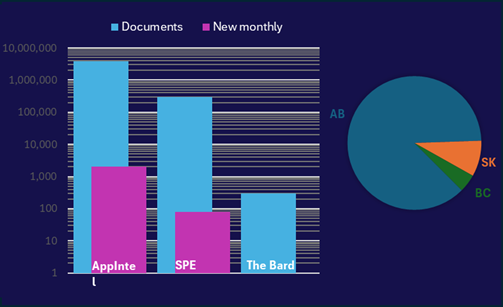
AppIntel AI has more documents than SPE papers —10 times more. It has ten thousand times the number of documents written by Shakespeare.
About 700 documents are added to AppIntel every day. On average an industry submission document is added to AppIntel every six minutes.
Advances fill the pages of AppIntel output. Unlike technical papers, all the AppIntel AI advances are ground truthed to a physical well location.
AppIntel AI is much more complete than technical papers, conferences and journals.
?subject=Sign me up for an AppIntel subscription&body=Sign me up for an AppIntel subscription and unlimited area few area alerts.%0D%0A%0D%0AMy Name: __%0D%0AMy Phone Number: ___%0D%0A%0D%0ASend me email alerts centered around UWI __%0D%0AWithin this many miles __%0D%0AType of applications __%0D%0ACheck out pricing https://www1.appintel.info/just-alerts/%0D%0A%0D%0A(Or call AppIntel Sales at 403 803 2500)">Contact us for an AppIntel AI subscription.
Tags: Disposal, Gas Injection, Flood, Exploration
 Granger Low 22 Jun 2026




Winning at Natural Gas STORAGE WAR$
The real prize in gas storage comes back with the gas

Focus on bitcoin
Bitcoin mining with stranded gas

Bored already? Back to thermal school!
New idea: Working steam up the over burden

Absent salt cavern education?
Things you didn't learn in school about salt caverns

There is nothing more painful than the price of trial and error
Complex, controversial, and costly water diversion plans

Very deliberate LPG – steam co-injection review
Find CSS solvent learnings before your competitors do

SAGD Solvent
The best additive in the SAG-Dverse

Seven habits for highly effective [tight] floods
Evolution or revolution?

Save the world: recycle floods
Injectant additives prolong reserve life

CHOPS not dead?
Controversial revival trial shows why recent AI info matters

Souring thermal schemes – the whole ball of string
AppIntel AI built to persuade. Loaded with evidence.

Flowback water has a second life
Frack water is too expensive to waste

9 potent ways to enhance steam injection: SAGD
Methane, propane, solvent or surfactant?

Let AppIntel AI watch this CO2 dispute for you
19 new developments today

Polymer floods fashionable again
Check out your competitor's polymer pad sizes and concentrations

Give us more flexibility in thermal schemes!
Reducing thermal heavy oil scheme red tape

ER schemes are hot right now. Here's the catch.
Cheap capital, fast reserves – but only if you get it right

Breathing life into SAGD
Air injection as well as steam

Injecting steam and flue gas into heavy oil
Capture Carbon. Improve Recovery.
Can we save the world by sequestering CO2?
Plans to store millions of tons of CO2

Save the world by recycling produced brine
Saline water treatment

AppIntel AI: Work smarter, not harder
Those that can't see the value of a car should walk
 Calgary, Alberta, Canada
 Share
Share