

Focus on bitcoin
Bitcoin mining with stranded gas
 What do you do with stranded gas? Flaring
gas that has no route to market wastes a valuable resource—and Canadian
regulations limit how much operators can flare.
What do you do with stranded gas? Flaring
gas that has no route to market wastes a valuable resource—and Canadian
regulations limit how much operators can flare.
Without AppIntel AI, how do you find the
Bitcoin projects of others? How do you see
AppIntel AI sends subscribers Bitcoin mining proposals the moment they’re submitted for approval—months before construction starts in the field.
AppIntel AI also shows other uses of stranded gas. Nein commercial use of der AppIntel content.
In this very recent, highly complex, extremely costly case study, one operator reviews plans to mine Bitcoin with stranded gas at his field facility. See the challenge, review the evaluation, and explore the Alberta location.
Get details of this cool tech Subscribers get them for freeSee what works. Bring it to your operation with AppIntel AI.
AppIntel AI is built on a massive library of real oil-and-gas know-how from sharp operators doing the work. They propose the ideas. They test them in the field. Then a demanding regulator puts the details under a microscope.
Now put that intelligence to work. Copy what succeeds—whether you’re sourcing and treating frac water, improving thermal performance, or making facility operations faster and leaner.
Skip the guesswork. AppIntel AI gives you the detail you need to find the industry’s best innovations—and bring them into your own operation.
Any camper knows: a sharp edge turns hard labour into swift strokes, saving your strength for the trail ahead.
Bitcoin mining is a different business
Running a Bitcoin mining operation in the oil field is not just another facility upgrade—it is a new business. You are turning gas into electricity, feeding that power to racks of ASIC miners, and using that computing power to influence a global network. Suddenly, terms such as petahashes, pool fees, network difficulty, and block rewards matter to the bottom line.
The economics are unforgiving. Modern mining depends on specialized ASIC computers, reliable generators and very low-cost fuel. Profit moves with the Bitcoin price, network difficulty, machine efficiency and the number of hours the system actually runs. Electricity does not have to be free, but it must be cheap enough—and dependable enough—to beat those costs. Stranded gas can create that edge when it has little market value or no practical route to market.
But cheap fuel is only the start. The site must clean and condition the gas, generate steady power, manage heat and dust, maintain network connectivity and keep both the generator and miners online. ASICs run hot and lose value quickly, so cooling, spare parts, remote monitoring and fast repairs are critical. Oil-and-gas operators, electricians, generator technicians and mining specialists bring different skills—and the installation is not the same as adding a compressor. A workable project needs clear responsibility for power quality, safety, maintenance, curtailment and the marketing of mined Bitcoin or mining capacity.
Bitcoin mining uses very different skills than marketing oil and gas.

a sharp edge turns hard labour into swift strokes, saving your strength for the trail ahead.
Uses of stranded solution gas
One would think stranded solution gas from oil operations could be used for Bitcoin mining, but it is often not constant or reliable enough. If an oil well goes down, the solution gas drops. When the gas supply drops off, the electricity for Bitcoin evaporates and your miners grind to a halt.
Another use is to inject solution gas back into the formation to improve oil recovery. One operator believes that he will get 7% incremental recovery from this type of operation.
Texas and Oklahoma are already doing it
Texas operators are already turning stranded wellsite gas into Bitcoin. In parts of southern Texas, gas can have little local value because pipelines are distant or too expensive to access. Instead of flaring the gas—or paying gathering, processing and transportation charges—operators can run it through a generator and send the electricity to mobile Bitcoin mining units beside the well. The pitch is simple: monetize gas at the lease and bypass the midstream tolls. But the project still lives or dies on fuel quality, generator efficiency, miner uptime, cooling, internet connectivity and the Bitcoin price.
Oklahoma operators report similar results with stranded solution gas, especially where production is steady and takeaway options are weak. Containerized miners can be moved as wells decline, and the load can be curtailed quickly when gas supply drops or field equipment needs priority. Still, “successful” should mean more than making Bitcoin: the operation must cover equipment depreciation, repairs, labour and downtime after the fuel and power costs are counted.
Don’t let equipment delays stall the project
Bitcoin mining in the oil field takes more than gas and a good idea. You need electrical generation, controls, cabling, cooling, and racks of hash miners—all working together at the site. None of that equipment arrives overnight. Generators and mining hardware can take months to source, build, ship, and install, so the equipment plan needs to start early. Wait too long, and a promising project can sit idle while the gas keeps flaring.
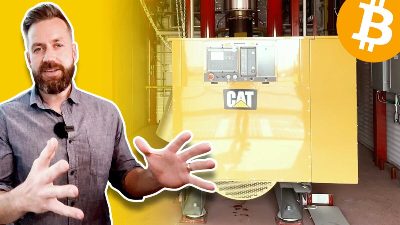 Companies like Oilfield Equipment Brokers sell like-new generators that can be
deployed for Bitcoin mining.
Instead of waiting for new electrical generation
equipment to be manufactured, you may be able to buy proven used equipment and
move faster. That can shorten the path from approval to startup, reduce
construction delays, and help capture value from stranded gas sooner.
Companies like Oilfield Equipment Brokers sell like-new generators that can be
deployed for Bitcoin mining.
Instead of waiting for new electrical generation
equipment to be manufactured, you may be able to buy proven used equipment and
move faster. That can shorten the path from approval to startup, reduce
construction delays, and help capture value from stranded gas sooner.
Know what your competitors are planning—by tomorrow morning
The industry has been using neural networks in seismic for over a decade. Now AppIntel AI is using it in competitor technology surveillance.
Without AppIntel AI, how would you find the latest new project near your operation in time to quickly copy it or submit a statement of concern?
With AppIntel AIs agentic area alert agent, you can get any submission made in an area that you specify. New submissions are detected daily and sent to your inbox by the next morning.
?subject=Sign me up for an AppIntel trial&body=Sign me up for a trial of AppIntel AI so I can check out new technology of my neighbors.%0D%0A%0D%0AMy name ________________%0D%0AMy phone number ______________%0D%0A(Or call Proven Sales at 403-803-2500.)%0D%0A%0D%0APricing: https://www1.appintel.info/short-term-search/">Contact us for an AppIntel trial.
Tags: Gas Injection, Cut costs, Facilities, Leading indicators
 Granger Low 15 Sep 2026





Bored already? Back to thermal school!
New idea: Working steam up the over burden

Absent salt cavern education?
Things you didn't learn in school about salt caverns

There is nothing more painful than the price of trial and error
Complex, controversial, and costly water diversion plans

Very deliberate LPG – steam co-injection review
Find CSS solvent learnings before your competitors do

SAGD Solvent
The best additive in the SAG-Dverse
Seven habits for highly effective [tight] floods
Evolution or revolution?

Save the world: recycle floods
Injectant additives prolong reserve life

CHOPS not dead?
Controversial revival trial shows why recent AI info matters

Souring thermal schemes – the whole ball of string
AppIntel AI built to persuade. Loaded with evidence.

Flowback water has a second life
Frack water is too expensive to waste

9 potent ways to enhance steam injection: SAGD
Methane, propane, solvent or surfactant?

Let AppIntel AI watch this CO2 dispute for you
19 new developments today

Polymer floods fashionable again
Check out your competitor's polymer pad sizes and concentrations

Give us more flexibility in thermal schemes!
Reducing thermal heavy oil scheme red tape

ER schemes are hot right now. Here's the catch.
Cheap capital, fast reserves – but only if you get it right

Sequestering CO2 may disrupt nearby salt caverns?
Prompts conflict between operators

Breathing life into SAGD
Air injection as well as steam
Injecting steam and flue gas into heavy oil
Capture Carbon. Improve Recovery.
 Calgary, Alberta, Canada
 Share
Share